

Institutions of higher education (IHE) face many cross-cutting challenges, including but not limited to the
following: sustaining student satisfaction and enrollment, maintaining accreditation, funding demands, compliance
regulations, changing learning and working modalities, digital transformation, information sharing, and protecting
assets and data against cyberattacks. In recent years, cybersecurity challenges have surged in the higher
education space, and the situation is expected to worsen.
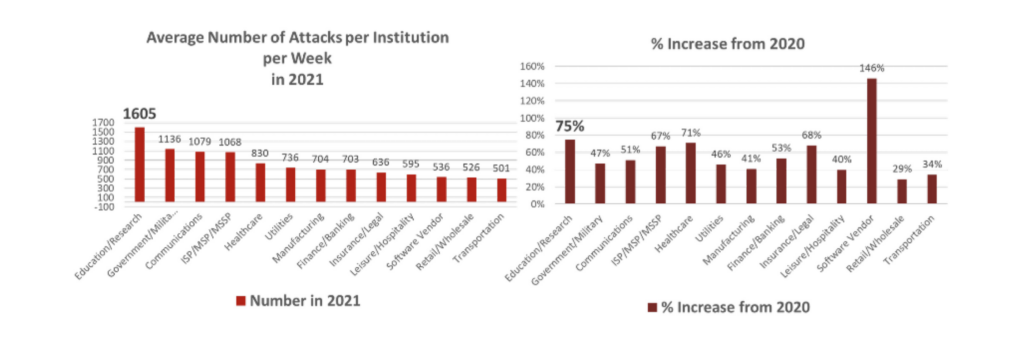
According to Check Point Research, IHE was the top target for cyberattacks in 2021, with an average of 1,605
cyberattacks per institution per week, which is a 75% increase from 2020¹. In comparison, other industries globally
saw an increase of 50%.
IHE requires a top-down approach to develop cyber strategies for evolving threats.
The IHE must leverage information technology and cybersecurity governance, risk management, and cybersecurity best practices planned from the top down to protect the confidentiality, integrity, and availability of sensitive data and valuable assets from cyberattacks.
IHE provides a target-rich environment from various perspectives.
Humans are the weakest link in the cybersecurity protection chain. Cybercriminals know it. Cybercriminals exploit it. Universities are prime targets for cybercriminals who use social engineering to disrupt services or access university assets.

Cybercriminals will persist in using low-skill, low-effort attack methods to access high-value data and assets for identity theft or financial gain. Social-engineering, such as phishing scams, deceives students, faculty, and staff, granting unauthorized access to valuable information. Man-in-the-middle attacks have also increased, tricking unsuspecting parents and students into paying tuition on websites that impersonate legitimate university payment portals.
Stricter Regulatory Requirements: Pennsylvania approves legislation barring state and local governments
from using taxpayers’ money to pay randoms and making it illegal to possess, develop, sell, or threaten the
use of malware in Pennsylvania³.
Despite the challenging outlook for IHE security, a robust cybersecurity program can minimize the impact of cyber attacks. It’s not a question of if a university will face a cyberattack, but when. The key defense is to establish a comprehensive cybersecurity program involving all university stakeholders, beyond the conventional IT and cybersecurity staff.
Additionally, IHE must also consider outsourcing portions of its cybersecurity program to assist with the affordability, scalability, and relevancy of a resilient cyber program. Federal and state compliance regulations (i.e., FERPA, Sarbanes-Oxley Act, Gramm-Leach-Bliley Act. HIPAA, etc.) will continue to be updated. Balancing these evolving requirements adds to the workload of many resource-constrained universities.
Cybersecurity must be threaded throughout the fabric of the university to protect against cyber attacks.
Below is a high-level roadmap for developing or enhancing an IHE cybersecurity program. While note a step-
by-step guide, these activities are minimum recommendations for the resilient program. Universities may have
completed some of these steps, but updates may be needed due to evolving regulations.
Moreover, to reduce expenditures and resources, consider outsourcing some activities. Outsourcing offers
benefits such as accessing skilled professionals with the right expertise at the right time, while also reducing
implementation and sustainment costs compared to in-house development.
Sources